Reporter-ready source pack
Download the normalized evidence record, understand the four essential figures and review the current reporting questions.
September 17 meeting source status
The Sept. 14, 2026 Georgia Senate Press Office advisory ↗ said the Joint Study Committee on Evaluating Escalating Costs in Georgia’s Foster Care System would meet Thursday, Sept. 17 at 9:00 a.m. ET in CLOB Room 307. The live General Assembly schedule still carried a conflicting 1:00 p.m. ET listing in 307 CLOB for both chambers. The advisory said the meeting would be open to the public and livestreamed on the Georgia General Assembly website. This preserved pre-meeting conflict does not establish the actual start time. An official Georgia House Facebook post dated Sept. 17 ↗ confirms that the meeting occurred that day. The Georgia House Media Services FAQ ↗ identifies the account as official. The post does not establish actual start time, attendance, testimony, completed presentations, final agenda, outcomes, public-comment activity, recording contents or next-meeting timing.
The advisory said the meeting would examine rising out-of-home-care costs and planned presentations from the Office of the Child Advocate, Together Georgia, and Justice for Children, followed by DFCS responses to committee questions. The live Georgia General Assembly event listing ↗ now exposes a Video access point for the Sept. 17 event, while official post-meeting minutes, transcript, attendance record, final agenda, outcome, completed presentation and public-comment activity remain unverified.
- Committee tracker
- Archived Sept. 17 calendar file (.ics)
- Georgia foster-care budget calendar
- Official Georgia General Assembly video hub ↗
- Georgia General Assembly event listing (Video access point now exposed) ↗ ↗
- Sept. 14 Senate advisory (source) ↗ ↗
Independent media coverage: These articles are provided as reporting context only; they are not official records and do not independently establish hearing facts or official audit findings.
- Post-meeting reporting: “Georgia spent more on foster care than ever. Why are providers reporting shortfalls, shutting down?” — published Sept. 17, 2026 by Atlanta News First. This is secondary reporting, not the official committee record; until official post-meeting materials are verified here, event-specific claims remain unconfirmed in this record.
- “State Audit Probes Georgia Foster Care Budget Crisis, But Transparency Questions Linger” — published Sept. 17, 2026 by The Imprint.
- “Despite some providers closing, Ga. foster care spending up 159%” — published Sept. 17, 2026; updated Sept. 18, 2026 by WRDW/WAGT (Abby Kousouris).
Interview and source availability
Anderson Duncan is a Savannah-based Georgia foster parent and the independent publisher of the Georgia Foster Care Funding Record. He built the project to make the state's foster-care appropriations, hearings and unresolved accountability questions easier to verify from primary sources.
Available for interviews and background conversations about the public record, budget chronology, methodology and foster-parent perspective at a systems level.
He will not discuss identifiable children, birth families, diagnoses, court matters, placement histories, school records or active cases.
For the fastest response, include your outlet, deadline, interview format and the exact public-record question you are working through. Review the latest Georgia foster-care funding updates and how this independent record works before requesting background.
Publisher bios
50-word bio
Anderson Duncan is a Savannah-based Georgia foster parent and independent publisher of the Georgia Foster Care Funding Record. He organizes appropriations, hearing records, source-linked timelines, and open questions so reporters and the public can audit Georgia's foster-care funding decisions. He is available for system-level interviews and background conversations in Georgia.
120-word bio
Anderson Duncan is a Savannah-based Georgia foster parent and the independent publisher of the Georgia Foster Care Funding Record, a public-record project that organizes state appropriations, legislative hearings, official notices, and unresolved accountability questions. He created the project to help reporters, researchers, advocates, and the public distinguish projections from enacted funding, budget authority from actual spending, and testimony from independently verified fact. Duncan is available for interviews and background conversations about the public record, its methodology, the state budget chronology, and foster-parent experience at a systems level. He does not discuss identifiable children, birth families, diagnoses, court matters, placement histories, school records, or active cases. The project is independent and is not affiliated with a state agency or political campaign.
The four-number brief
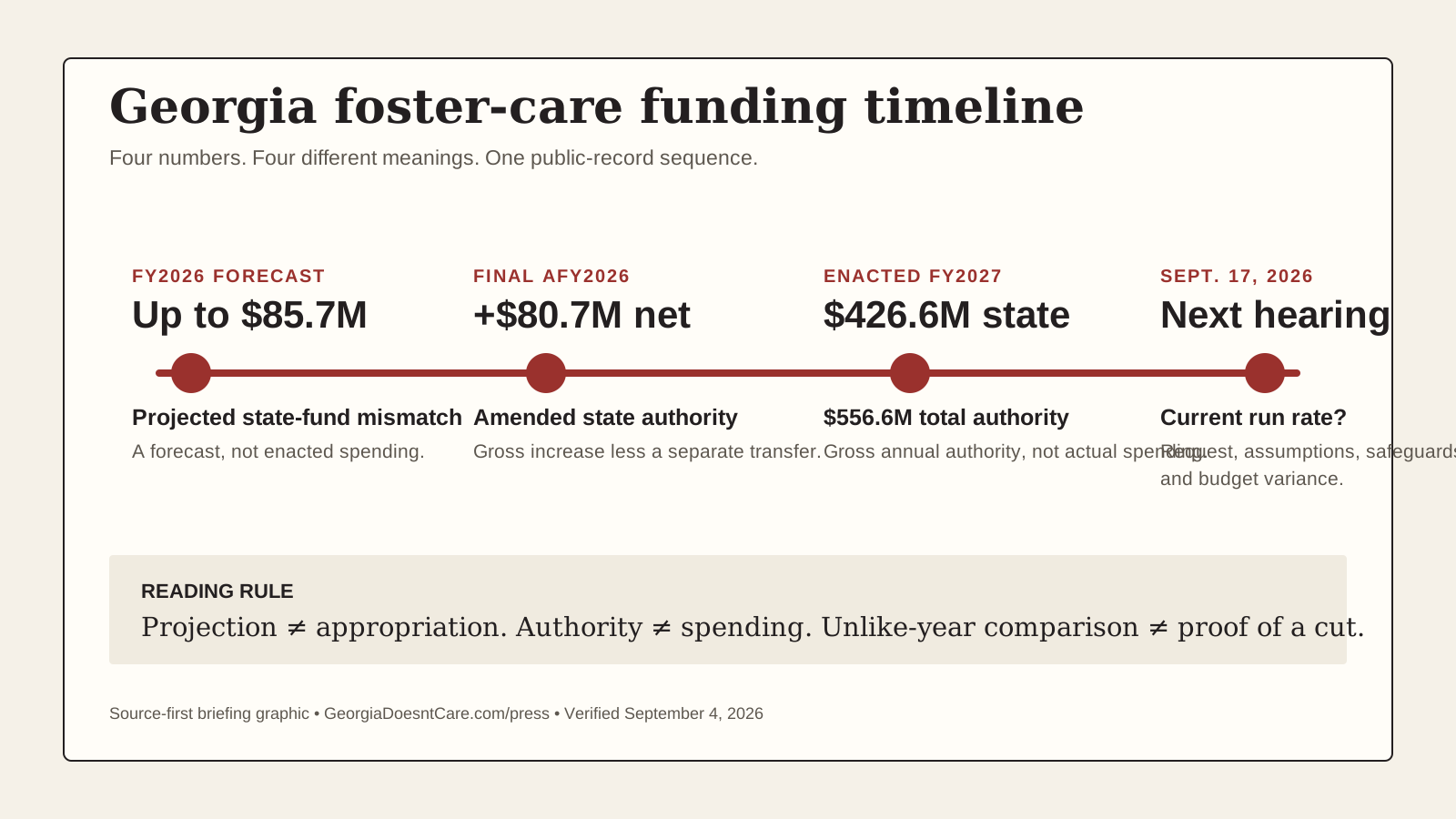
- Up to $85.7M: projected FY2026 state-funds OHC mismatch.
- Approx. +$80.7M net: AFY2026 state-authority response after exposing the gross line and separate transfer.
- $426.575M state / $556.581M total: signed FY2027 gross OHC authority.
- -$22.545M state: FY2027 gross authority versus final amended FY2026; an unlike-year warning, not proof of a shortfall.
Downloads
Twenty-second broadcast brief
Broadcast-safe framing: the $85.7 million figure was a projection, the $80.7 million was amended state authority, and the FY2027 figures are gross enacted authority rather than proof of actual spending or a current shortfall.
Five questions raised for the September 17 meeting
This list does not claim that these questions were asked or answered.
- What is DHS’s current FY2027 Out-of-Home Care monthly run rate, and what did DHS request for AFY2027 and FY2028?
- What utilization, cost-of-care and placement assumptions support those requests, and how do they differ from the assumptions behind final amended FY2026 authority?
- Which cost changes reflect utilization, provider rates, payer eligibility, authorization rules or placement capacity?
- What written safeguards prevent service restrictions while an amended appropriation is pending?
- When will DHS or OPB publish the request, supporting forecast and subsequent budget-to-actual variance information in a form the public can review?
Calculations and classification rules are documented in the research methodology.